An old lady picks up a brimming crockpot and totters back and forth as she tries to walk across the room. Liquids, equidistant from poles of homogeneity and emulsification and littered with hunks and flecks of matter varying in color, size and structural-rigidity, slosh perilously in a single wave that breaks constantly and barely seeps out from under the clear glass lid before dribbling over the sides and onto the floor. The old lady remains oblivious to the slosh and the drips of multi-colored steaming slush she transports, and carries out her practical task of moving with no regard for the way in which age has tightened some of her bolts and loosened others and generally distorted a once-graceful glide into a frenetic, animatronic lurch....
----------------------------------------------------------------
I woke up in the Stop and Drop bed, iPod alarm sounding insistently, and found that the old lady from my dream had my guts. Yesterday’s lunch was now preeminently influencing my consciousness. This was awful. Miriam was also quite unwell, though not so fiercely as I. She made the trek upstairs and retrieved our morning rations on a tray, and I decided that I’d better give dry bread half a chance, and so slowly dissected my crusty roll. We debated simply taking the day off, a reluctant first up to that point in an otherwise busy journey. We didn’t take the day off, but we waited until the afternoon to return by bus to the old city and check out the official black market. There are exactly zero photos from this day, because we were warned (by Footprints and Lonely Planet and, I think, our hostel proprietors) that carrying too many goodies might be a bad idea in this part of town. However, all of the discomfort that we felt during this outing was digestive, and I wouldn’t give Polvos Azules the distinction of a particularly dangerous part of Lima, unless you’re in charge of copyright enforcement.
This time, we exited our bus toward the end of the great big park that signals the approach to the old city. From here we walked to the edge of that park and back along another massive road to one of the largest intersections that I had ever seen, where police officers were stationed in the road to direct the traffic and also in elevated boxes on the street corners wrapped in yellow vinyl
Inca Cola signs. We crossed two streets and began to see vendors selling metal implements, vicious looking knives and knuckles and a handgun or two generally with smaller items and jewelry sprinkled around. It seemed like we must be getting close, and in two more blocks we found ourselves in the shadow of the vibrant blue concrete structure we sought.
Entering Polvos Azules is just like going to a run-down mall only, unlike the case of run-down malls that I’ve encountered in this hemisphere, this mall is disproportionately alive compared with spots in the U.S.A. that feature its crumbling facades, permanently fused escalators and unkempt stalls. This place and the shoppers and vendors therein showcased a wonderful divide between the desire to have these properly prestigious artifacts of current media and fashion (at least insofar as they were reasonable facsimiles) and the indignation that most main-stream urban consumers in the U.S.A. would feel at having to procure them in a space that has no interest in sharing in this sparkling, consumptive aesthetic. We moved from overcast afternoon sun into the dim fluorescence of the great, blue box-cave, which smelled like frying oil and dusty cardboard rolled in sugar. The whole thing had the feel of something between a warehouse and a parking garage.
Aside from simply wanting to see the market, we had the idea that we should pay special attention to the offerings from the knock-off clothing vendors for especially witty instances of Engrish. We’d seen a few good shirts up to that point on our journey, though I don’t recall specifically what they said. The first stalls on our end of the first floor we visited in Polvos were skater/surfer/generally-male themed, then there were the girlie dress shops, the video-game shops with a couple of young guys each playing futbol or shooting zombies, the movie shops, the tool shops, the camera shops, the cellphone vendors, the poster shops, and some shops whose theme was anyone’s guess and that seemed to carry a little bit of everything. We made one pass down the length of one floor before we realized just how gigantic this box actually was.
Miriam decided, or more precisely was selected, to undertake the job of reviewing the facilities, and we followed signs to a weird shanty on the roof guarded by a wizened man at a card table rolling two sheets of toilet paper into little bundles and also selling some assortment of unmarked productos higenicos para damas. I fished out fifty soles and some extra napkin wadding from one of my pragmatically overstuffed pockets, Miriam paid the old man and I waited, gazing out off the roof into the sea of buildings. I was beginning to feel unwell again, and pulled a cracked pink bismuth tablet from my pocket before slowly chewing it and working pieces of it loose from my molars. I had no lust to fully confront my errant plumbing on this rooftop, and kept it to myself for the time being.
Miriam came back out, not too impressed, but at least somewhat relieved. And we went back in to take another look at potentially hilarious shirts. Miriam may dispute this claim, but I don’t remember coming across too many really exceptional examples, and the Engrish generally lacked the spontaneity of stereotypical Japanese examples where the object is to arrange spatio-aesthetically acceptable combinations of English words. The shirts we found in Polvos often seemed to be constructed by making screen-prints based on actual designs of shirts sold by major labels transposed from some kind of degenerate source material like a low-res online preview image or an out of focus snapshot. Images came through this process perceptibly unscathed, but text was rendered retarded through the use of what seemed like attempts at applying OCR to the fuzzy source text.
This was the kind of stuff that they’d counterfeited. The large, messily aligned letters of “Abercrombie and Fitch” or “American Eagle” or “Rip Curl” or “Billabong” were clear enough, and then all the half-faded gibberish writing that is (was?) frat-boy fashion catnip du jour made little to no sense and often contained obvious algorithmic garbage characters. It’s difficult to understand all that effort undertaken to loosely copy something so cheesy, but once you’d stuck your head into this locus of fashion, it was impossible not to notice the fact that nearly everyone who had any business trying to look hip on a budget in Lima was sporting this swag. I was beginning to come unglued, something that I will admit is regularly a part of extended encounters with retail that I undertake without a clear enough goal. Miriam took her time, and I progressed from the slumped shuffle of the overshopped to the tighter, more erratic, gait of someone who feels as though they might void their bowels arbitrarily.
Eventually, we just gave up, not sufficiently enchanted with any one piece of Polvos Azules, but reticent to leave such a grand oddity without some official talisman. Back on the street, the air was still hot and oily, but the breeze felt good, and I bought some kind of coolish fizzy liquid from a woman with a cart. Early field reports from the pink molecules I’d sent in to civilize and organize my sub-esophageal riffraff suggested that perhaps my intrepid chemical strike force (this is a bad metaphor, I assume they’re really more like a specialized hugging brigade) was making headway in its campaign. We crossed back along the great intersection and entered the park alongside a museum surrounded by temporary fences, apologetic signage, and construction flotsam. The evening was coming, though how fast exactly was hard to say. I sipped soda and Miriam and I tried to decide what was to be done next. We’d been told that it was essential that we go see the lighted fountains display (http://www.circuitomagicodelagua.com.pe/), a major spectacle that happened a couple nights a week, and we determined that we wouldn’t have enough time to return to Miraflores and grab cameras before the show. Instead, we went straight to the park and got in line.
The sun set shortly after we paid our five dollars each and walked toward a towering, multi-colored, triangular grid formed by wide, high-pressure jets of water. The magic water circuit sprawls within a fenced park, and passes under a road by way of a tunnel lined with a giant (highly political) photographic essay on the impact of the construction of this park on the surrounding community. The park was an amazing place to watch people of all ages, and by the time we emerged from tunnel they were beginning to pack-in tightly. Without really trying, we found ourselves in a throng waiting for the exposition of the fantasía fuente. The fantasy turned out to be a pretty amazing combination of laser and digital image projection onto screens of flowing water, set to a number of generic classical masterpieces (when isn’t Beethoven an appropriate selection? no, really, I’m asking) and numerous repetitions of El Condor Pasa. Luckily, the crowd was mostly armpit tall, so it was very easy for me to see what was really an incredible visual feast. I had a good view of the lasers blasting through the plumes of water and right into the windows of an adjacent apartment building, whoops!
After the fantasía finally burned itself out, we wandered the rest of the circuit in the increasingly brisk darkness. It was fun, and the air in the park was weird and highly variable: sea breeze meeting city heat meeting cool mist meeting dense crowds. Any sadness we felt at not having brought our cameras along for the day’s outings, was allayed seeing nearly everyone snapping copious photos and videos on all manner of devices (google it, see every fountain in detail). We made sure that we’d checked all the fountains, and then circuited fully, out to the street. We hopped a bus and squeezed together for the loud, windy, bumpy ride.
Showing posts with label Peru. Show all posts
Showing posts with label Peru. Show all posts
Wednesday, February 16, 2011


Sunday, January 30, 2011
Video Feature - Lima Driving
This is the view from the guts of a collectivo: the lumbering, honking, metal beasts of Lima's flowing petro-chemical circulatory system. I'm not sure how well these videos express the absurdity of this kind of driving, but I hope they at least provide a few empirical nuances to my attempts at description.
Saturday, January 29, 2011
Lunch in the Old City
I caught my breath on the bus long enough to notice as it stuck again in my throat in a jarring, bumping, no-margins what-so-ever glide into older, grander, dingier parts of Lima. The five or so rough lanes of traffic on the wide boulevard were swimming with the old metal busses, starting, stopping, lurching and careening so close to one another that it seemed there must be some kind of mad magic guiding the hands of the drivers and cushioning the hulking rigid bubbles that seemed destined to crumple one another without warning. I had a nervous grin plastered on my face, and my hands polished well-worn holds as I craned my neck to watch close call after close call whoosh by. The boulevard, for all its grandiose scale, was inconsistently covered, with large sections dropping several inches at a time and jostling over archaeological bricks and pavers. Our course led through a landscape which changed from big box retailers and KFC's (both literal, and some other chicken joints which included casinos), to huge parks full of public works and fantastic old buildings, to a dense crumbly center of shored-up, throbbing, antique city.
We stepped out of the bus onto the hot street and were met with a face-full of smells that were initially hard to place. As we walked, it became apparent that the odor was the product of an entire district of printing businesses, all churning out brightly colored posters and pirate media covers. Beyond this area we found the district that we'd been looking for, blocks full of rooms open to the street each with a placard announcing its menu. After this much time spent in transit, we were at a loss to choose a place and we picked our restaurant slowly and poorly.
From the outside most of the places looked the same, and the difference in price was something that only people truly out of whack in terms of budget and exchange rate delirium would have quibbled over, and so, as I recall, we made the unfortunate decision to low-ball it. We ended up with a truly scary spread: glistening lettuce, a goblet of clearish liqud that appeared to have something grainy like the end of a glass of juice, strange fish, sinister-looking seaweed, gristle, bone, repeated helpings of rice-bean slurry and an off-yellow jello.
Our discomfort was further complicated by a conversation with a man who was trying to hard-sell us a lunchtime serenade via the improbable technique of telling us that we lacked the capacity for the true, deep musical expression like that of indigenous people like himself. The man was unpleasant, the food more-so, and yet things were so busy in the hot dark room that we remained at the mercy of this musical extortionist and his pitch, unable to pay our bill. We left abruptly, feeling bad about wasting awful food and worse about being picked on while doing so.
The vibe was not so good, and the crowds in the streets that day were packed-in tightly and eager for sols. We walked in circles briefly before finding the first hostel (closed) and then the second hostel we hoped to investigate. We were ushered into a very old waiting room full of deteriorating antiques and a pleasant funk, then through a pair of locked doors into what all senses was unmistakably a hospital. At three beds to a room, a rate hike, and the promise of a horrible schlep to get our stuff there, we were not impressed and waited to be let out again.
We needed to redeem the old city, at least for the purposes of this first visit, so we kept walking. The square was beautiful, sunny, filled with weird stuff to look at, Saints' identities to debate and little old ladies to talk to.
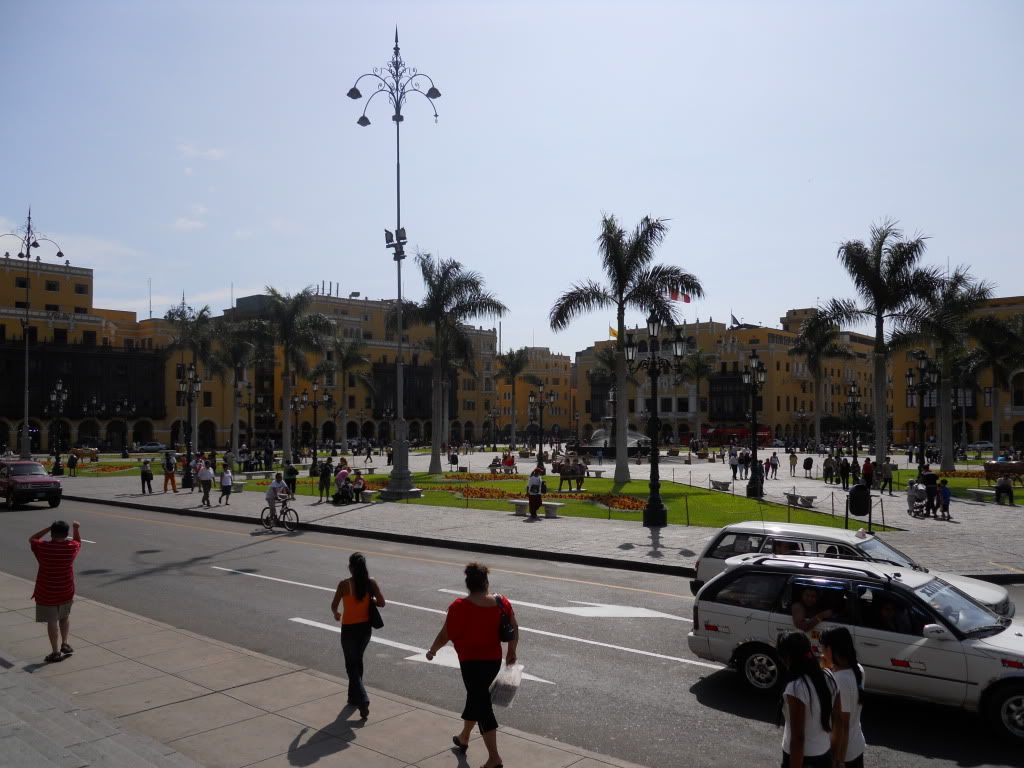
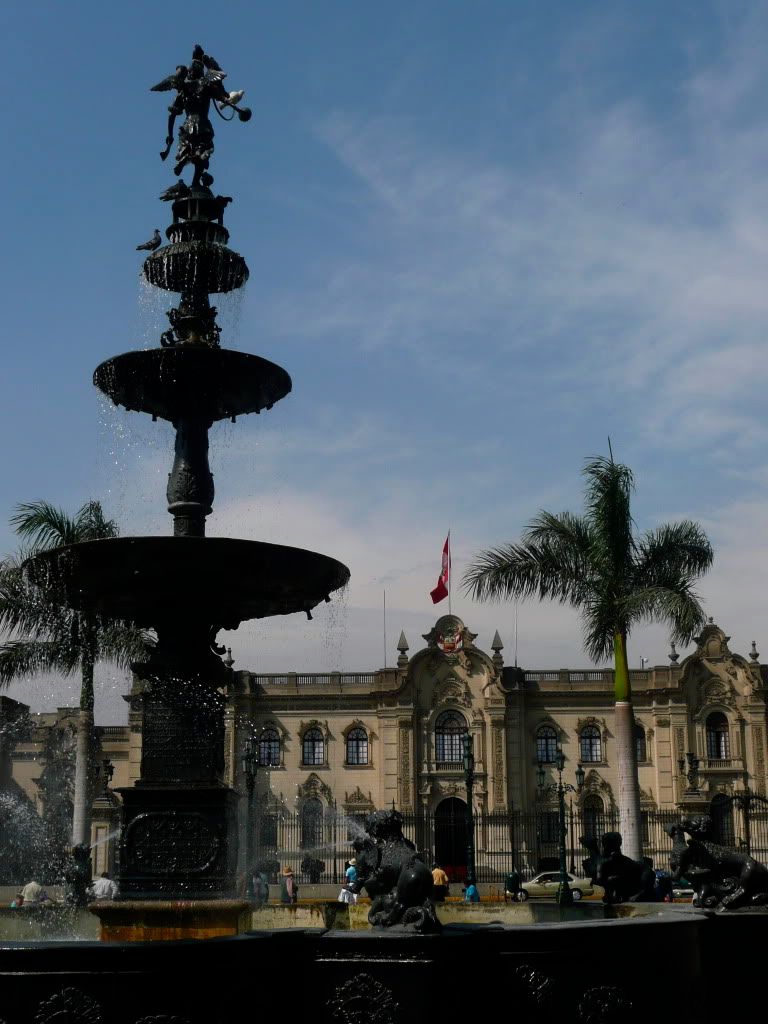
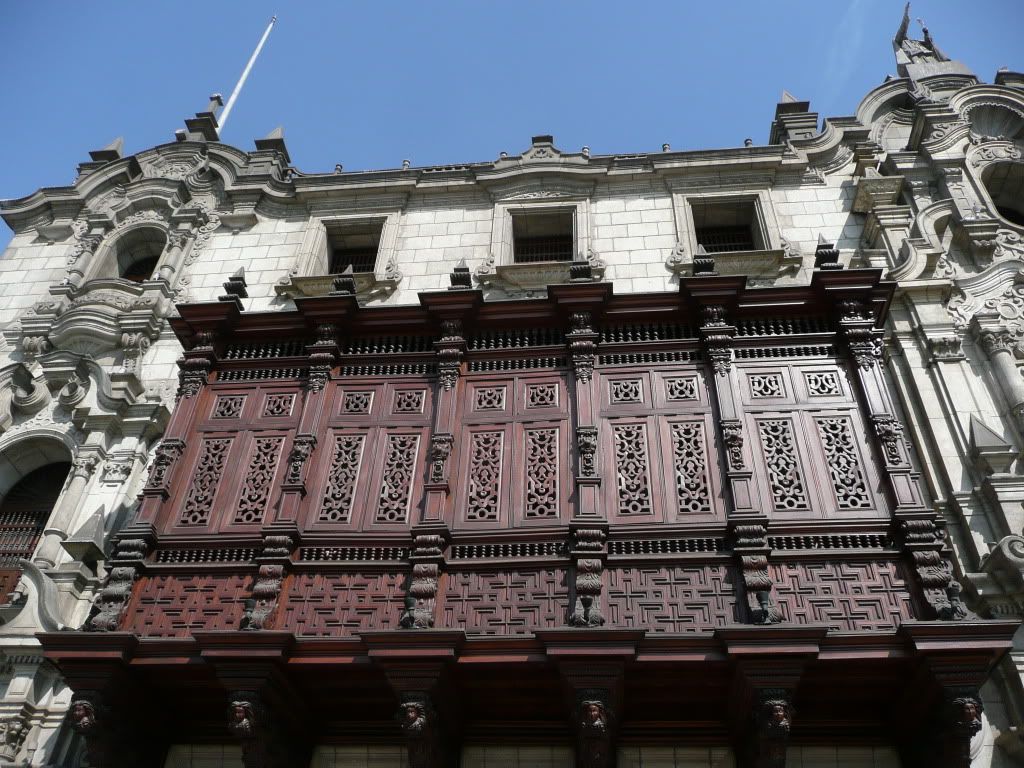
The buildings in this part of Lima, as should now be apparent, are extremely ornate and colorful, and on the other side of the square we turned right and came to a pink building with a glass ceiling full of women trading in collectible objects: coins, bills, photos, all kinds of bits and pieces wrapped in cellophane. I went in to be cool.

After this, we almost turned back, but half a block further we ran into a whole lot of stalls out in the sun. Posters, books, prints, textiles, toy guns, guns on the backs of soldiers strolling pairs of soldiers. Dear reader, if you'll recall them from our video shot in Parque Central, we were once more surrounded by familiar geometric solids protruding from the paved thoroughfare. Off toward what I think was the North, a hillside peppered with colorful boxes was set behind a frothy brown river under a suspension bridge.
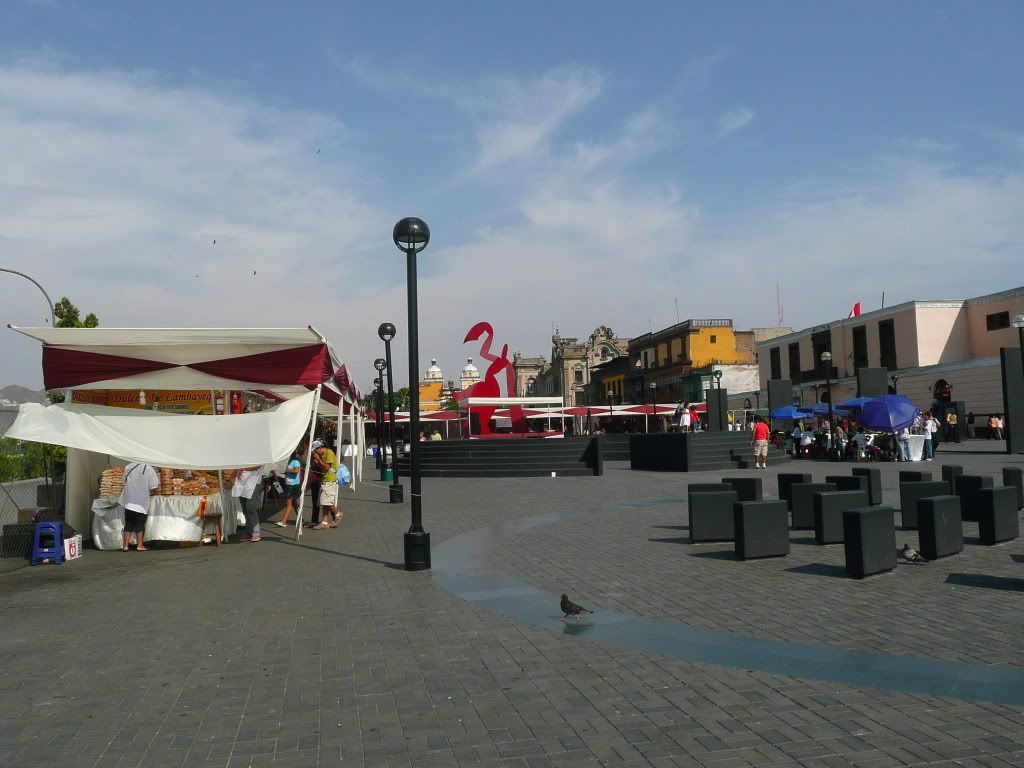
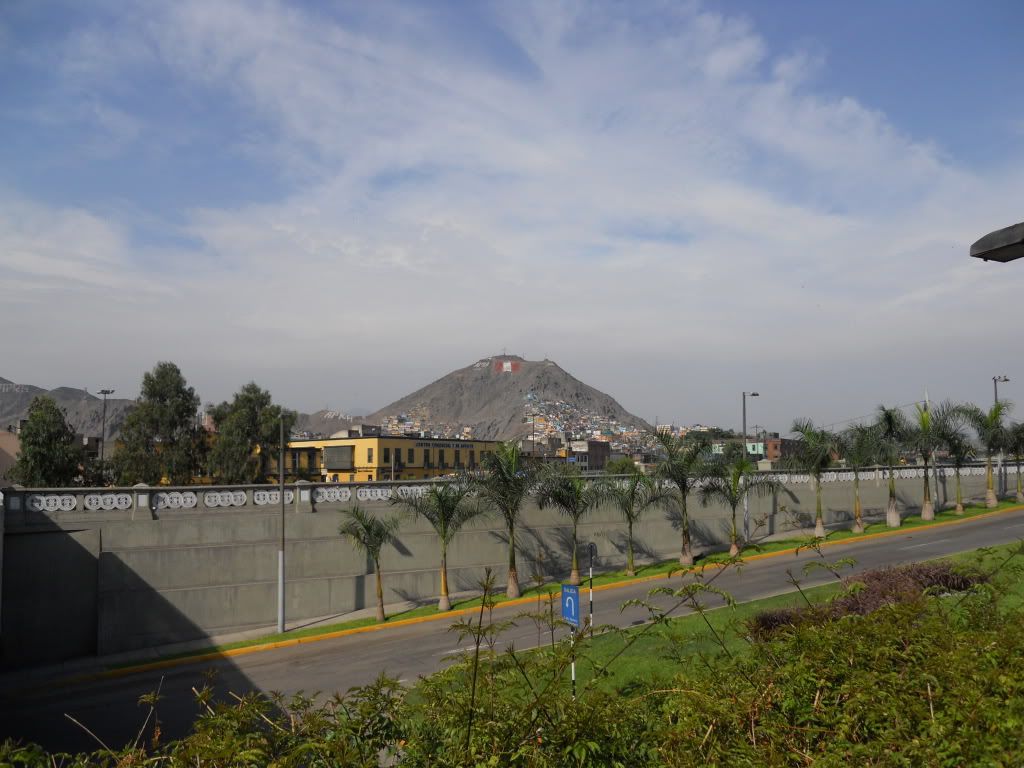
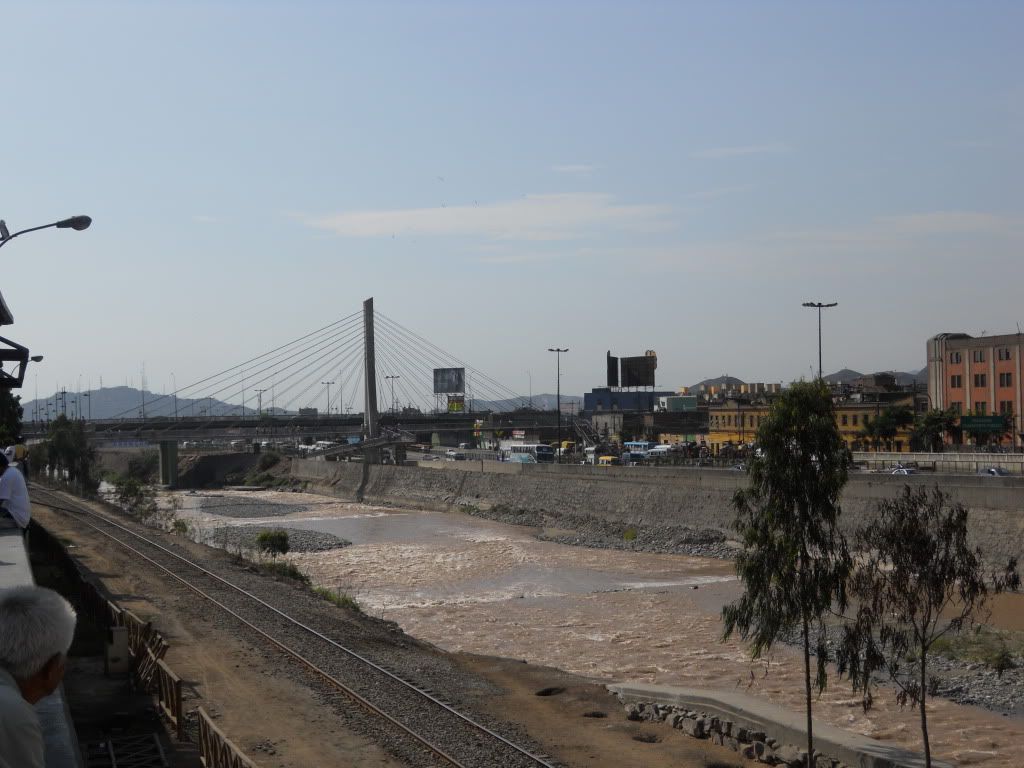
A man with a microphone strung from a small amplifier preached an uncomfortably earnest gospel to no one in particular, and we started to head for shade and cold drinks, when we spotted the food. There, piled in the sun, were heaps of wonderful everything, ceviche, cuy, choclo, a perverse Peruvian smorgasbord! I was still not hungry, in fact still quite unappetized by our unfortunate lunch, Miriam is blessed with the powers of temporary amnesia and instantaneous hunger in situations of obvious deliciousness, and was quickly served up a heaping plate of exquisite.
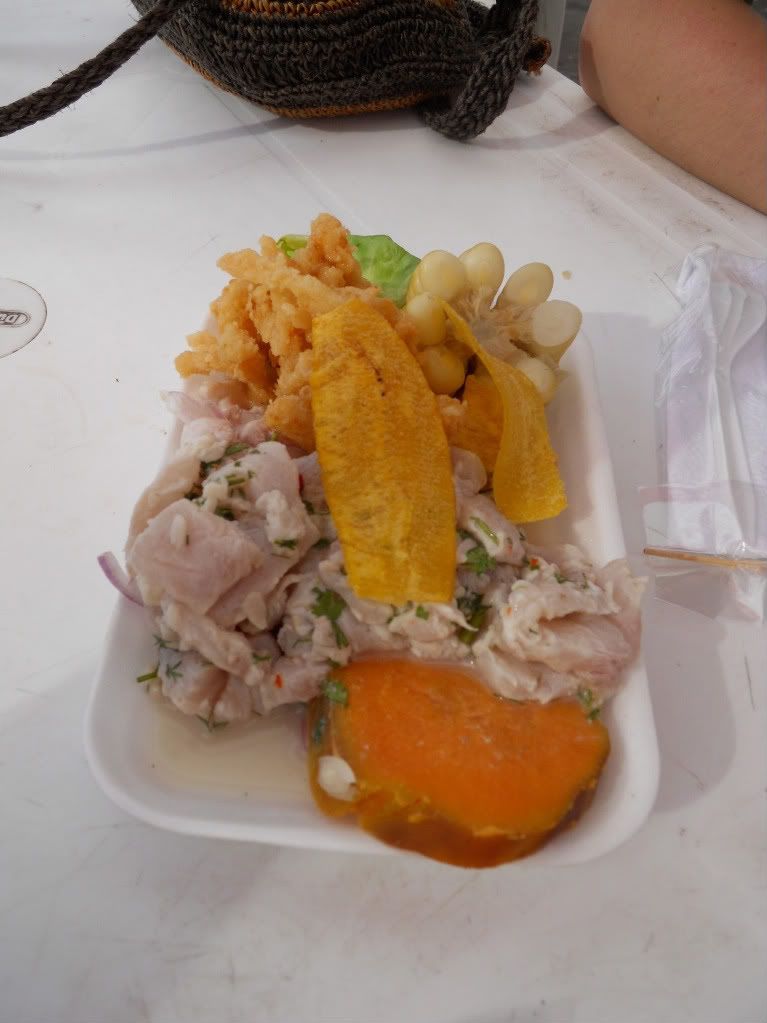
To complement this munching, we were offered the stylings of the saddest mime ever, a young man who's boxed entrapment and briefcase pantomime drew yawns and muffled golf claps from even those in the crowd who seemed to be obvious stooges (relatives). Poof! the ceviche vanished into the mid-afternoon heat, and we resumed our wandering. We adopted a brisk pace back in the general direction of the street that we had come by, stopping to look at gnarled church carvings and full-service dentist/doctor/surgeon/obgyn boutiques for the do-it-yourself type. We were slowed only briefly by a strange, mustachioed fellow wearing a Hawaiian shirt who took up about two minutes chit chatting and only pulled out the ol' "Taxi?" "Weed?" bit after I'd summoned all of my linguistic powers to tell him that we were late and needed to get a move on.
The afternoon was nearly played-out by this point, and we had to make the hostel in time to ask politely if we could re-check-in and avoid having to move in the dark. We caught the bus back and hopped out at the corner of Parque Central...
We stepped out of the bus onto the hot street and were met with a face-full of smells that were initially hard to place. As we walked, it became apparent that the odor was the product of an entire district of printing businesses, all churning out brightly colored posters and pirate media covers. Beyond this area we found the district that we'd been looking for, blocks full of rooms open to the street each with a placard announcing its menu. After this much time spent in transit, we were at a loss to choose a place and we picked our restaurant slowly and poorly.
From the outside most of the places looked the same, and the difference in price was something that only people truly out of whack in terms of budget and exchange rate delirium would have quibbled over, and so, as I recall, we made the unfortunate decision to low-ball it. We ended up with a truly scary spread: glistening lettuce, a goblet of clearish liqud that appeared to have something grainy like the end of a glass of juice, strange fish, sinister-looking seaweed, gristle, bone, repeated helpings of rice-bean slurry and an off-yellow jello.
Our discomfort was further complicated by a conversation with a man who was trying to hard-sell us a lunchtime serenade via the improbable technique of telling us that we lacked the capacity for the true, deep musical expression like that of indigenous people like himself. The man was unpleasant, the food more-so, and yet things were so busy in the hot dark room that we remained at the mercy of this musical extortionist and his pitch, unable to pay our bill. We left abruptly, feeling bad about wasting awful food and worse about being picked on while doing so.
The vibe was not so good, and the crowds in the streets that day were packed-in tightly and eager for sols. We walked in circles briefly before finding the first hostel (closed) and then the second hostel we hoped to investigate. We were ushered into a very old waiting room full of deteriorating antiques and a pleasant funk, then through a pair of locked doors into what all senses was unmistakably a hospital. At three beds to a room, a rate hike, and the promise of a horrible schlep to get our stuff there, we were not impressed and waited to be let out again.
We needed to redeem the old city, at least for the purposes of this first visit, so we kept walking. The square was beautiful, sunny, filled with weird stuff to look at, Saints' identities to debate and little old ladies to talk to.
The buildings in this part of Lima, as should now be apparent, are extremely ornate and colorful, and on the other side of the square we turned right and came to a pink building with a glass ceiling full of women trading in collectible objects: coins, bills, photos, all kinds of bits and pieces wrapped in cellophane. I went in to be cool.
After this, we almost turned back, but half a block further we ran into a whole lot of stalls out in the sun. Posters, books, prints, textiles, toy guns, guns on the backs of soldiers strolling pairs of soldiers. Dear reader, if you'll recall them from our video shot in Parque Central, we were once more surrounded by familiar geometric solids protruding from the paved thoroughfare. Off toward what I think was the North, a hillside peppered with colorful boxes was set behind a frothy brown river under a suspension bridge.
A man with a microphone strung from a small amplifier preached an uncomfortably earnest gospel to no one in particular, and we started to head for shade and cold drinks, when we spotted the food. There, piled in the sun, were heaps of wonderful everything, ceviche, cuy, choclo, a perverse Peruvian smorgasbord! I was still not hungry, in fact still quite unappetized by our unfortunate lunch, Miriam is blessed with the powers of temporary amnesia and instantaneous hunger in situations of obvious deliciousness, and was quickly served up a heaping plate of exquisite.

To complement this munching, we were offered the stylings of the saddest mime ever, a young man who's boxed entrapment and briefcase pantomime drew yawns and muffled golf claps from even those in the crowd who seemed to be obvious stooges (relatives). Poof! the ceviche vanished into the mid-afternoon heat, and we resumed our wandering. We adopted a brisk pace back in the general direction of the street that we had come by, stopping to look at gnarled church carvings and full-service dentist/doctor/surgeon/obgyn boutiques for the do-it-yourself type. We were slowed only briefly by a strange, mustachioed fellow wearing a Hawaiian shirt who took up about two minutes chit chatting and only pulled out the ol' "Taxi?" "Weed?" bit after I'd summoned all of my linguistic powers to tell him that we were late and needed to get a move on.
The afternoon was nearly played-out by this point, and we had to make the hostel in time to ask politely if we could re-check-in and avoid having to move in the dark. We caught the bus back and hopped out at the corner of Parque Central...
Friday, January 28, 2011
Later That Day
We got out three maps before leaving the Stop and Drop to explore the old city and wrote down the names of some other hostels to investigate. If you've ever looked at a guidebook on Peru or South America more generally you might already be aware that Lima defies what I had considered widely held cartographic assumptions and expectations. There is no such thing as a map of Lima, rather the reference materials consisted of maps of vague seemingly inconsistent sections, districts, and regions of greater Lima (this should give you some idea what I'm talking about) as it splashes back from the coast and up into the hills.
So we looked at our maps, holding them up next to one another, or flipping pages back and forth to try to construct a cohesive vision of the route, thought about it for a while, stashed our bags in some lockers and headed off on foot. This seemed like something that people could do, even given that we were getting hungry and it was probably 95 degrees.
We walked and talked our way up through a long shady park set between the lanes of a wide divided road. Eventually, we ran out of Miraflores and its consistent and plentiful foliage found ourselves walking along mostly a lot of sunny residential streets interspersed with gigantic crossings, roundabouts and other traffic-shaping devices that seemed all seemed gigantic. We managed to figure out how to traverse a number of these traffic formations without becoming unfortunate road splatter before coming to this point:
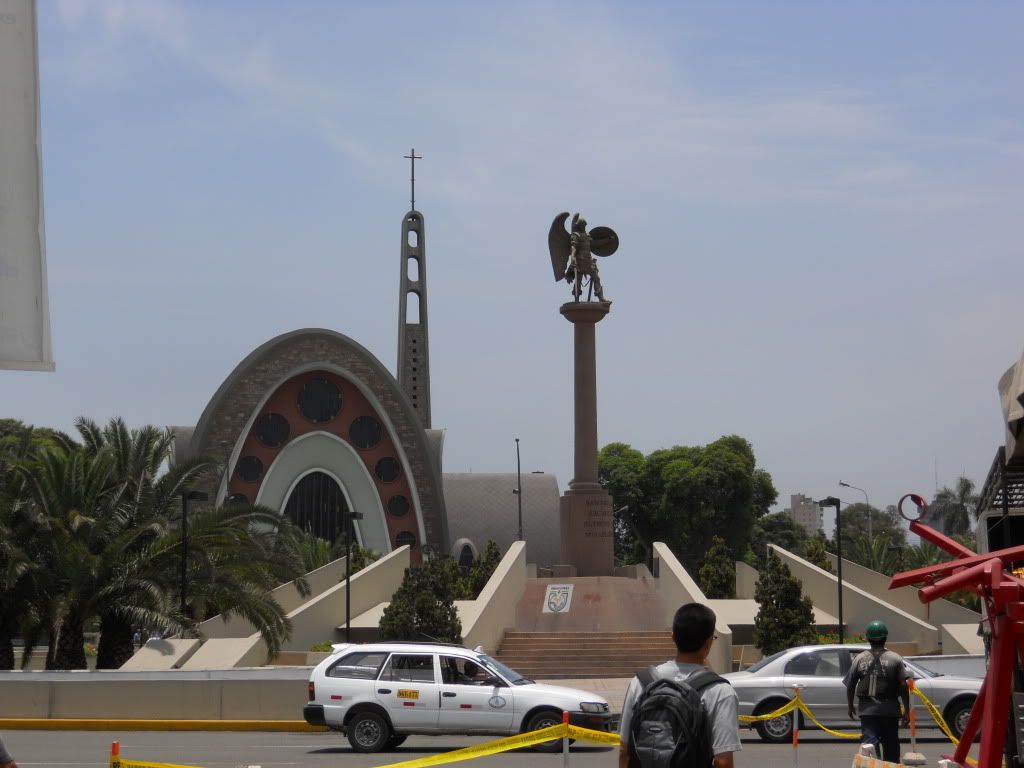
We worked our way around this circus, and, as we did, got to watch a lot of traffic negotiating. We waited at a crosswalk, fantasizing aloud about finding lunch by this point, and watched as a man with a clipboard yelled to all the bus drivers who passed this corner and then received some amount of coin in a can borne by what I guessed was probably a nine year-old boy. Mostly, this system seemed to be tuned to a degree that was remarkable. Words flew back and forth, the kid stood in the gutter and held the can aloft, change was deposited smoothly, and then as we watched the pace of traffic started to pick up. The next bus that yielded at the corner had only a few seconds before the bus driver felt himself inextricably yanked into the flow of traffic. Words were being exchanged, but as the bus lurched past the corner the change was cast hastily into the street. The man with the clipboard quickly assigned blame and meted out punishment to the youth, though it seemed apparent to me that the backhand was redundant, the kid was already looking dejected about his poor performance in the face of this challenging can-handling scenario.
Miriam and I drank some of our warm, metallic water and resumed our walk. As we moved along we brought out our maps again and tried to get some sense for how far we had come. Two of the maps, the ones with tight views of Miraflores and the Old City were completely useless. We had come to a place of dubious importance to even the most intrepid of casual guidebook urban Lima hikers. Presently, I located the big St. Michael roundabout on the map, we estimated our movements to this point as having been approximately 1cm per hour. At this rate we would reach our destination in a matter of hours, not minutes. We started to look around for alternative modes of transportation.
In a city of seven million taxis, the ones that we saw in this part of Lima had that distinctive *Taxi for a Day* look that we now found unappealing both in terms of general threat to life and property and because we didn't want to have to try to feed directions to another taxi driver who knew about as much as we did about where we were and how to get where we wanted to go. We emerged again from neighborhoods onto a new, dry-grassy median-park and back within the network of the collectivos. In two or three blocks we had gotten our change together and found some people to ask for a proper vector toward a bus that would get us to the old city.
Eventually, in a way I would become familiar with as the way these rides always begin, a dingy white bus with stickers proclaiming a range of religious affiliations slid up to the curb, preceded by the voice of the man who hung from the door hocking rapidfire locations with names jumbled together like a practiced auctioneer. This man is almost always ferociously convinced (and convincing) that his bus is the one that you need to get you to where you need to go, and will only really clarify directions once the heat of the stop has given way to the brief and intermittent reprieve of collecting fares, doling out tickets and getting repositioned for the next corner sell. We sat in the bus, feeling the fake, oily, wind of vehicular acceleration. My legs ached a little, my shoulders relaxed and filled the grooves left by bags slung heavily and shifted unconsciously from arm to arm over the course of an accidental hike...
So we looked at our maps, holding them up next to one another, or flipping pages back and forth to try to construct a cohesive vision of the route, thought about it for a while, stashed our bags in some lockers and headed off on foot. This seemed like something that people could do, even given that we were getting hungry and it was probably 95 degrees.
We walked and talked our way up through a long shady park set between the lanes of a wide divided road. Eventually, we ran out of Miraflores and its consistent and plentiful foliage found ourselves walking along mostly a lot of sunny residential streets interspersed with gigantic crossings, roundabouts and other traffic-shaping devices that seemed all seemed gigantic. We managed to figure out how to traverse a number of these traffic formations without becoming unfortunate road splatter before coming to this point:

We worked our way around this circus, and, as we did, got to watch a lot of traffic negotiating. We waited at a crosswalk, fantasizing aloud about finding lunch by this point, and watched as a man with a clipboard yelled to all the bus drivers who passed this corner and then received some amount of coin in a can borne by what I guessed was probably a nine year-old boy. Mostly, this system seemed to be tuned to a degree that was remarkable. Words flew back and forth, the kid stood in the gutter and held the can aloft, change was deposited smoothly, and then as we watched the pace of traffic started to pick up. The next bus that yielded at the corner had only a few seconds before the bus driver felt himself inextricably yanked into the flow of traffic. Words were being exchanged, but as the bus lurched past the corner the change was cast hastily into the street. The man with the clipboard quickly assigned blame and meted out punishment to the youth, though it seemed apparent to me that the backhand was redundant, the kid was already looking dejected about his poor performance in the face of this challenging can-handling scenario.
Miriam and I drank some of our warm, metallic water and resumed our walk. As we moved along we brought out our maps again and tried to get some sense for how far we had come. Two of the maps, the ones with tight views of Miraflores and the Old City were completely useless. We had come to a place of dubious importance to even the most intrepid of casual guidebook urban Lima hikers. Presently, I located the big St. Michael roundabout on the map, we estimated our movements to this point as having been approximately 1cm per hour. At this rate we would reach our destination in a matter of hours, not minutes. We started to look around for alternative modes of transportation.
In a city of seven million taxis, the ones that we saw in this part of Lima had that distinctive *Taxi for a Day* look that we now found unappealing both in terms of general threat to life and property and because we didn't want to have to try to feed directions to another taxi driver who knew about as much as we did about where we were and how to get where we wanted to go. We emerged again from neighborhoods onto a new, dry-grassy median-park and back within the network of the collectivos. In two or three blocks we had gotten our change together and found some people to ask for a proper vector toward a bus that would get us to the old city.
Eventually, in a way I would become familiar with as the way these rides always begin, a dingy white bus with stickers proclaiming a range of religious affiliations slid up to the curb, preceded by the voice of the man who hung from the door hocking rapidfire locations with names jumbled together like a practiced auctioneer. This man is almost always ferociously convinced (and convincing) that his bus is the one that you need to get you to where you need to go, and will only really clarify directions once the heat of the stop has given way to the brief and intermittent reprieve of collecting fares, doling out tickets and getting repositioned for the next corner sell. We sat in the bus, feeling the fake, oily, wind of vehicular acceleration. My legs ached a little, my shoulders relaxed and filled the grooves left by bags slung heavily and shifted unconsciously from arm to arm over the course of an accidental hike...
Tuesday, January 25, 2011
Terremorning
We got up the next morning in time for breakfast, and tottered droopily between the room and bathroom and then upstairs to the communal area. This morning, we were on time to catch several other travelers on stools and couches around the upstairs room watching a series of televised news reports on a massive earthquake that had severely rattled the coast and central valley of Chile in the early morning hours that day.
Everyone was focused intently on dark shaky images of crumbling buildings and yelling people, and two girls from Chile were offered phones to try to contact loved-ones. The whole thing was a shock and, beyond the magnitude of the tectonic upheaval itself, threw our visit to Chile into question. We had our rolls, butter, jam and tea, and then we hit the pavement. Our plan was to check all the available airline offices for deals to Cusco. Surely, we would see more of Peru than Lima and the road.
When we arrived at the LAN office, the doors were chained and all the Friedas had been given the day off. LAN's servers, a guard told us, were located in Santiago and were down. We tried a few more offices, meeting with a variety of helpful and less helpful characters, and coming to understand that posted fares did not include the fees imposed on foreigners traveling by air in-country. Our Cusco trip was essentially foiled, and we stopped by an internet joint and headed back to the hostel.
At this point, we had to figure out how to best explore the monstrous nexus of Lima. Once back in the room, we examined the list of stuff I'd compiled from the guidebooks on the bus two nights before. We planned to stash our bags and go looking for a new (cheaper) place to crash in the old city, a journey north and inland from our digs in Miraflores. In the old city, we were told that we could get some thrifty lunch, see some excellent old buildings, and stop in at the official black market, a place called Polvos Azules. We were also advised to see a gigantic fountain-light spectacle after dark some night. As well, we decided to try our hands at getting out to a set of ruins 25k south of the city called Pachacamac, as they seemed to be the oldest, biggest thing we'd be able to reach before leaving Peru again.
Preview of next installment: We do all of this and more!
Everyone was focused intently on dark shaky images of crumbling buildings and yelling people, and two girls from Chile were offered phones to try to contact loved-ones. The whole thing was a shock and, beyond the magnitude of the tectonic upheaval itself, threw our visit to Chile into question. We had our rolls, butter, jam and tea, and then we hit the pavement. Our plan was to check all the available airline offices for deals to Cusco. Surely, we would see more of Peru than Lima and the road.
When we arrived at the LAN office, the doors were chained and all the Friedas had been given the day off. LAN's servers, a guard told us, were located in Santiago and were down. We tried a few more offices, meeting with a variety of helpful and less helpful characters, and coming to understand that posted fares did not include the fees imposed on foreigners traveling by air in-country. Our Cusco trip was essentially foiled, and we stopped by an internet joint and headed back to the hostel.
At this point, we had to figure out how to best explore the monstrous nexus of Lima. Once back in the room, we examined the list of stuff I'd compiled from the guidebooks on the bus two nights before. We planned to stash our bags and go looking for a new (cheaper) place to crash in the old city, a journey north and inland from our digs in Miraflores. In the old city, we were told that we could get some thrifty lunch, see some excellent old buildings, and stop in at the official black market, a place called Polvos Azules. We were also advised to see a gigantic fountain-light spectacle after dark some night. As well, we decided to try our hands at getting out to a set of ruins 25k south of the city called Pachacamac, as they seemed to be the oldest, biggest thing we'd be able to reach before leaving Peru again.
Preview of next installment: We do all of this and more!
Saturday, September 11, 2010
Before We Dropped
This footage was shot after our return from dinner that first night in Lima.
I refer, in the video, to flight scheduling. Specifically, Miriam had, during our fine time with the ladies of LAN, noticed both an abundance of domestic airline offices and an advertisement for flights to Cuzco that seemed within the realm of financial possibility. Our plan for the following morning consisted of booking one of these flights and getting the hell out of Lima for three days of Ruins and mountains before returning to fly to Buenos Aires. Nothing to it...
I refer, in the video, to flight scheduling. Specifically, Miriam had, during our fine time with the ladies of LAN, noticed both an abundance of domestic airline offices and an advertisement for flights to Cuzco that seemed within the realm of financial possibility. Our plan for the following morning consisted of booking one of these flights and getting the hell out of Lima for three days of Ruins and mountains before returning to fly to Buenos Aires. Nothing to it...
Friday, September 10, 2010
Sunday, April 25, 2010
Real-time Homecoming and A Hot Day in Piura
Jiggity Jig - April 25, 2010
I'm back in Iowa (likewise, Miriam is back in Pennsylvania). This actually happened about four days ago, but I still haven't quite gotten used to the feeling. The adventure is still warm in my senses and on my limbs. The way to describe this place and its familiar features seems to take the form of only one word, thus far: opulence.
My stomach too seems to be experiencing difficulty understanding what has happened in the last few days. Suddenly the milk is fresh again, not that stuff that will stand forever at room temperature in a box. The cupboards are brimming full with a well-stocked collection of the rare elements that drive tastebuds mad the world over. My guts aren't prepared for this access, and they're letting me know that I must take things slowly.
Anyway, among the opulent features of the life I find myself rejoining is a constant access to the internet, which should be a real boon insofar as the updating of this blog is concerned. So, without dwelling any longer on understanding and telling the concluding portions of this tale, let me continue with our trudge into the depths of Peru.
-----------------------------------------------------------------------
We sat, sweating and thumbing through our respective guidebooks (Peru was the only country for which we had afforded this kind of redundancy, hauling both the Footprints 2010 and the Lonely Planet 2008). We had already bought our tickets from Piura to Lima, and were now on an endurance race to kill the many hours that lay between us and our departure time, something like 1800 hrs, in the least unpleasant way. I don't remember exactly what we were looking for in our books, and in fact the search was probably more of a general survey of Peru-bound possibilities, but I do remember at least one thing that we found.
Somewhere in Lonely Planet 2008, I think near the front of the book and perhaps in a section giving some cultural overview of the country to be toured, I ran across a passage warning travelers about a known hazardous time of year for the South America sojourner: Semana Santa. Holy week, the book informed, was a time when all forms of transportation and lodging clogged with use, and also a time when fares were jacked up from sixty to one hundred percent. Unfortunately, for erstwhile Lutherans like myself, holy week is not something that falls on a hard and fast date year after year. Rather, one can find it lurking vaguely in the range of March-April. This, as many of you know, was nearly the entire range of our trip, and a very scary unknown indeed.
We left the bus terminal, each of us carrying all of our possessions once again, and hobbled off through the streets of Piura. We had goals now, and because the sun had not yet reached its zenith we were still confident in our ability to enjoy accomplishing them.
The first problem to be addressed was a lack of food. Our maps of Piura were terrible, and we ended up at a bank first, so Miriam withdrew some Nuevo Soles. As we once again entered the flow of Piura foot traffic, we began to notice that we were still too early in the morning to hope to find food on the street that was not sold in a package. We sat down on some benches in front of a huge church and waited in the shade for half an hour. Now things were beginning to wake up, this must have been around 1000hrs. We located a little place that appeared to do some food and while I ate a jamon y queso, Miriam tried out the first ceviche of Peru, one so memorable for its quality that she would reference it throughout the remainder of our trip. It was a refreshing, albeit not (relatively) cheap desayuno: the ceviche probably cost between three and four dollars.
From there we walked back out to the main plaza and had a look around. Miriam had noticed a tourist information office that had been closed before, adjacent the bank. That office was now open, air conditioned, and likely to know all about Peru's potential diversions and probably the precise dates of Semana Santa this year. We went in and were given what I found to be a completely hypnotic and exhaustive explication of every archaeological site in Peru by a pleasant young woman with a very methodical, rhythmic and soft tone. At one point, during something like the fifth of seven or so maps of different regions of Peru, my head slipped off of my left hand and lurched quite close to the table. After learning about more than a lifetime's worth of Peruvian attractions, we finally had the good sense to ask about the dates of holy week. Which, as it turned out, was scheduled for precisely the time when we would hurriedly revisit this expansive, international road trip on the way to a date with the Galapagos. We left, freaked out about our newfound scheduling debacle, though now equipped with an extensive collection of maps and pamphlets and two fine complimentary ballpoints.
Our next stop: LAN. We crossed the plaza again to investigate the true malleability of the terms and conditions of our South America Airpass. As I recall, we entertained a few ideas about how best to overcome the problems then coming to light in our itinerary. If we were lucky we could just rearrange things to suit this obstacle: shift each flight outright, cut out one leg, add another. If we were less lucky, we supposed, we might have to do something more drastic altogether, such as lose our second stint in Peru altogether and fly directly from Santiago back to Quito. As it turned out, neither of these options was within the range luck afforded. The details of our itinerary had become final once we made our initial flight, and any additions to the trip would fall under the insane pricing schedule that usually applies to foreigners flying under LAN. The best we could hope for was to shift the dates of one flight for a less insane fee, and hope for available buses when the time came.
As we left LAN, worried and somewhat underwhelmed by the apparent inflexibility of our trip, we soon forgot thoughts of our grandiose logistical problems in favor of thoughts such as "Why are we carrying all of our stuff right now?" or "Are we on the surface of the sun?" and, of course, "I know I'll regret saying this but, I wish we were on the damn bus already!" We dragged our under-rested bodies through the streets, almost as though we were pulling dying pack animals (ourselves) through some hellish desert, while onlookers smiled and chuckled, and made me wonder about just how stupid we looked and whether we weren't really that stupid. At that moment, we seemed to me extremely stupid, though a very nice person could probably get away with simply describing us as ridiculously unfortunate or perhaps retarded.
Not wanting to melt, and seeing few options aside from pushing on, we bought water, checked our email, and then headed for an ice cream shop. One great thing about traveling with Miriam is that ice cream has an almost cinematic ability to save the day.
This ice cream experience was, thankfully, no exception to the physics of Miriam, and the good vibe carried us back to the stifling bus station, and all through the end of the wait and the process of boarding. And that's where the next chapter begins: on the road to Lima.
I'm back in Iowa (likewise, Miriam is back in Pennsylvania). This actually happened about four days ago, but I still haven't quite gotten used to the feeling. The adventure is still warm in my senses and on my limbs. The way to describe this place and its familiar features seems to take the form of only one word, thus far: opulence.
My stomach too seems to be experiencing difficulty understanding what has happened in the last few days. Suddenly the milk is fresh again, not that stuff that will stand forever at room temperature in a box. The cupboards are brimming full with a well-stocked collection of the rare elements that drive tastebuds mad the world over. My guts aren't prepared for this access, and they're letting me know that I must take things slowly.
Anyway, among the opulent features of the life I find myself rejoining is a constant access to the internet, which should be a real boon insofar as the updating of this blog is concerned. So, without dwelling any longer on understanding and telling the concluding portions of this tale, let me continue with our trudge into the depths of Peru.
-----------------------------------------------------------------------
We sat, sweating and thumbing through our respective guidebooks (Peru was the only country for which we had afforded this kind of redundancy, hauling both the Footprints 2010 and the Lonely Planet 2008). We had already bought our tickets from Piura to Lima, and were now on an endurance race to kill the many hours that lay between us and our departure time, something like 1800 hrs, in the least unpleasant way. I don't remember exactly what we were looking for in our books, and in fact the search was probably more of a general survey of Peru-bound possibilities, but I do remember at least one thing that we found.
Somewhere in Lonely Planet 2008, I think near the front of the book and perhaps in a section giving some cultural overview of the country to be toured, I ran across a passage warning travelers about a known hazardous time of year for the South America sojourner: Semana Santa. Holy week, the book informed, was a time when all forms of transportation and lodging clogged with use, and also a time when fares were jacked up from sixty to one hundred percent. Unfortunately, for erstwhile Lutherans like myself, holy week is not something that falls on a hard and fast date year after year. Rather, one can find it lurking vaguely in the range of March-April. This, as many of you know, was nearly the entire range of our trip, and a very scary unknown indeed.
We left the bus terminal, each of us carrying all of our possessions once again, and hobbled off through the streets of Piura. We had goals now, and because the sun had not yet reached its zenith we were still confident in our ability to enjoy accomplishing them.
The first problem to be addressed was a lack of food. Our maps of Piura were terrible, and we ended up at a bank first, so Miriam withdrew some Nuevo Soles. As we once again entered the flow of Piura foot traffic, we began to notice that we were still too early in the morning to hope to find food on the street that was not sold in a package. We sat down on some benches in front of a huge church and waited in the shade for half an hour. Now things were beginning to wake up, this must have been around 1000hrs. We located a little place that appeared to do some food and while I ate a jamon y queso, Miriam tried out the first ceviche of Peru, one so memorable for its quality that she would reference it throughout the remainder of our trip. It was a refreshing, albeit not (relatively) cheap desayuno: the ceviche probably cost between three and four dollars.
 |
| From 2010-02-25 |
From there we walked back out to the main plaza and had a look around. Miriam had noticed a tourist information office that had been closed before, adjacent the bank. That office was now open, air conditioned, and likely to know all about Peru's potential diversions and probably the precise dates of Semana Santa this year. We went in and were given what I found to be a completely hypnotic and exhaustive explication of every archaeological site in Peru by a pleasant young woman with a very methodical, rhythmic and soft tone. At one point, during something like the fifth of seven or so maps of different regions of Peru, my head slipped off of my left hand and lurched quite close to the table. After learning about more than a lifetime's worth of Peruvian attractions, we finally had the good sense to ask about the dates of holy week. Which, as it turned out, was scheduled for precisely the time when we would hurriedly revisit this expansive, international road trip on the way to a date with the Galapagos. We left, freaked out about our newfound scheduling debacle, though now equipped with an extensive collection of maps and pamphlets and two fine complimentary ballpoints.
Our next stop: LAN. We crossed the plaza again to investigate the true malleability of the terms and conditions of our South America Airpass. As I recall, we entertained a few ideas about how best to overcome the problems then coming to light in our itinerary. If we were lucky we could just rearrange things to suit this obstacle: shift each flight outright, cut out one leg, add another. If we were less lucky, we supposed, we might have to do something more drastic altogether, such as lose our second stint in Peru altogether and fly directly from Santiago back to Quito. As it turned out, neither of these options was within the range luck afforded. The details of our itinerary had become final once we made our initial flight, and any additions to the trip would fall under the insane pricing schedule that usually applies to foreigners flying under LAN. The best we could hope for was to shift the dates of one flight for a less insane fee, and hope for available buses when the time came.
As we left LAN, worried and somewhat underwhelmed by the apparent inflexibility of our trip, we soon forgot thoughts of our grandiose logistical problems in favor of thoughts such as "Why are we carrying all of our stuff right now?" or "Are we on the surface of the sun?" and, of course, "I know I'll regret saying this but, I wish we were on the damn bus already!" We dragged our under-rested bodies through the streets, almost as though we were pulling dying pack animals (ourselves) through some hellish desert, while onlookers smiled and chuckled, and made me wonder about just how stupid we looked and whether we weren't really that stupid. At that moment, we seemed to me extremely stupid, though a very nice person could probably get away with simply describing us as ridiculously unfortunate or perhaps retarded.
Not wanting to melt, and seeing few options aside from pushing on, we bought water, checked our email, and then headed for an ice cream shop. One great thing about traveling with Miriam is that ice cream has an almost cinematic ability to save the day.
 |
| From 2010-02-25 |
This ice cream experience was, thankfully, no exception to the physics of Miriam, and the good vibe carried us back to the stifling bus station, and all through the end of the wait and the process of boarding. And that's where the next chapter begins: on the road to Lima.
Friday, April 16, 2010
Further Along The Road to Piura
After getting stamped and having brief conversations at two border crossing stations on opposite sides of Peru and Ecuador in the middle of the night we sat back down and expected a calm ride to Piura, a place I estimated to be between three and four hours down the road. It was around 2:30 AM, I thought, and finally consciousness slipped away, taking all my discomfort and cares with it.
I have had, since arriving on this new continent, a seemingly unending stream of extremely vivid, cinematic, adventurous and random dreams, replete with numerous cameo appearances from grade school classmates, camp friends, family members, pets and pretty much anyone from any group with which I've ever associated, especially my closest friends. Many have been lucid, but just as many have been so convincing, intense and engaging as to remind me of the handful of landmark dreams whose memory lingers from my youth. For example, I've had no less than five flying dreams in the space of less than two months. It's been fantastic, and I hope that this trend doesn't end immediately upon my return to the states. I don't remember exactly what I was dreaming as a drifted liminally on the bus, but I do remember that as I broke through the surface of real-time light and sound of the bus ride, I was deeply engaged with some otherworldly task and extremely reticent to use my tired eyes to see, my dry throat to speak, and my wrecked neck to focus my senses.
Harsh light and the prosody of assholes, something that is suprisingly transcendent of particular languages - at least within the spectrum of latin and germanic tongues - penetrated my sleep. Miriam was the one awake this time: "We need passports again, I think" she said, and prodded me back to life. I grabbed my documents and handed them to the two uniformed "Aduanas" (customs) men now making trouble on our bus. We had stopped again, this time for a seemingly random inspection, and after explaining that we were on the way to Lima, our interrogation terminated. The two men, each with baton and gun protruding garishly from heavy nylon belts and each wearing a thick vest with neon lettering that increased their chest sizes to the proportions of crazed roosters, now moved on to the family behind us.
As regular readers of this blog will recall, this was the family with two babes in arms who had taken to the feel of my hair, and had created something dreadlock-like on the back of my head as I fought to avoid water and create conditions that would support sleep. And now, I looked back at them, and despite the unfettered curiosity of the infants, they were a really cute family, and trying their best to make a good trip out of the worst bus seats available. Something, however, seemed to be not quite up to snuff about this little group of four, as far as the border enforcers were concerned, and as the father handed them his passport, things began to get tense. Miriam, I'm sure, had a better idea of what was actually being said, and will hopefully make her own account of these events known, but from my perspective, the police quickly took a situation in which the man spoke too casually toward them and escalated it into one in which they would instruct the man, and thus everyone else in this confined space on the importance of "respect". Things got testy, necks were strained, poses struck, voices raised, baton-handles grasped, and just when it seemed like it might get ugly, the police decided that all that these precursive gestures and hints of violence were sufficient for the time being, and the encounter wrapped up with an uneasy conviviality. It was truly Cartmanesque, and they overdid it, as if to say "What? You didn't really think we were mad did you? You didn't really think we'd use all these handy implements of destruction?"
The officers sauntered out of the bus and we got on our way. Welcome to Peru.
My dream did not return so easily after this, and the air conditioner had again begun to empty its constantly condensing bowels on we window-seated travelers. I looked out into the dark at the occasional ramshackle assemblages and sometimes more expansive structures of steel and concrete, unfinished modernist projects from bygone eras and derelict initiatives for housing development. The contrast from Quito and Cuenca was stark, and, thus far, I'd still felt little resonance with the memories I carried from my time in Southern-California-like Santiago or the multi-colored hillsides of Valparaiso. In time I drifted away again into the still-dark and dusty countryside.
The fourth or fifth awakening of the day came in Piura, some two or three hours later. This time we found our bus backing through a horde of people into a strange building unlike any bus terminal I had ever experienced before. The bottom floor of an old building had been converted into a very high-ceilinged garage-like enclosure, with a weird network of cages to help keep newly-arrived passengers free from a horde of taxi and moto-taxi (the three-wheeled conversion vehicle, like a rickshaw driven by some kind of engine between a chainsaw and a moped) eager to help with transportation, money changing and probably many other useful services. It was a skillion degrees(centigrade), as we retrieved our bags from under the bus, and we were immediately latched onto by a slender man pressing hard for a chance to be our taxi driver. Multiple attempts to get a moment to think and converse about what our next move ought to be by saying, "Perhaps," "Give us a minute," and a host of other brush-offs could not shake this tenacious fellow, and eventually, after seeing that he seemed quite clean, was asking for a fair but appropriately inflated gringo price, we gave in and followed him through the mass out into the street.
We got into the cab, somewhat nervously, and I watched as our host fastened his seatbelt and made the sign of the cross, both of which seemed terribly prudent and somehow reassured me. He then drove us, maniacally through a series of back streets in which we could have been gutted and robbed twenty times over, to a weird intersection where a man he described as his friend changed 10 dollars into roughly twenty-eight nuevo soles. This was good, our driver noted, don't change too much money, don't flash a big wad around here. We soon arrived at the Cruz del Sur bus terminal, from which we hoped to catch a bus that day onward to Lima, and paid our driver about a little over two dollars with our new soles. We had made it, and he thanked us for our patronage and gave us each a folded piece of paper full of verses about Jesus. Apparently we'd lucked into a real sweetheart of a cabbie, and he wanted us to know it for sure.
Miriam and I sat down in the waiting room of Cruz del Sur. It was all of 7 AM, and our bus would not be leaving until the late afternoon. We each carried two large bags, and were not looking forward to passing this day in the heat with this sort of luggage. For a few minutes, at least, we sat and talked about what was ahead.
Until next time, all the best from Portoviejo.
I have had, since arriving on this new continent, a seemingly unending stream of extremely vivid, cinematic, adventurous and random dreams, replete with numerous cameo appearances from grade school classmates, camp friends, family members, pets and pretty much anyone from any group with which I've ever associated, especially my closest friends. Many have been lucid, but just as many have been so convincing, intense and engaging as to remind me of the handful of landmark dreams whose memory lingers from my youth. For example, I've had no less than five flying dreams in the space of less than two months. It's been fantastic, and I hope that this trend doesn't end immediately upon my return to the states. I don't remember exactly what I was dreaming as a drifted liminally on the bus, but I do remember that as I broke through the surface of real-time light and sound of the bus ride, I was deeply engaged with some otherworldly task and extremely reticent to use my tired eyes to see, my dry throat to speak, and my wrecked neck to focus my senses.
Harsh light and the prosody of assholes, something that is suprisingly transcendent of particular languages - at least within the spectrum of latin and germanic tongues - penetrated my sleep. Miriam was the one awake this time: "We need passports again, I think" she said, and prodded me back to life. I grabbed my documents and handed them to the two uniformed "Aduanas" (customs) men now making trouble on our bus. We had stopped again, this time for a seemingly random inspection, and after explaining that we were on the way to Lima, our interrogation terminated. The two men, each with baton and gun protruding garishly from heavy nylon belts and each wearing a thick vest with neon lettering that increased their chest sizes to the proportions of crazed roosters, now moved on to the family behind us.
As regular readers of this blog will recall, this was the family with two babes in arms who had taken to the feel of my hair, and had created something dreadlock-like on the back of my head as I fought to avoid water and create conditions that would support sleep. And now, I looked back at them, and despite the unfettered curiosity of the infants, they were a really cute family, and trying their best to make a good trip out of the worst bus seats available. Something, however, seemed to be not quite up to snuff about this little group of four, as far as the border enforcers were concerned, and as the father handed them his passport, things began to get tense. Miriam, I'm sure, had a better idea of what was actually being said, and will hopefully make her own account of these events known, but from my perspective, the police quickly took a situation in which the man spoke too casually toward them and escalated it into one in which they would instruct the man, and thus everyone else in this confined space on the importance of "respect". Things got testy, necks were strained, poses struck, voices raised, baton-handles grasped, and just when it seemed like it might get ugly, the police decided that all that these precursive gestures and hints of violence were sufficient for the time being, and the encounter wrapped up with an uneasy conviviality. It was truly Cartmanesque, and they overdid it, as if to say "What? You didn't really think we were mad did you? You didn't really think we'd use all these handy implements of destruction?"
The officers sauntered out of the bus and we got on our way. Welcome to Peru.
My dream did not return so easily after this, and the air conditioner had again begun to empty its constantly condensing bowels on we window-seated travelers. I looked out into the dark at the occasional ramshackle assemblages and sometimes more expansive structures of steel and concrete, unfinished modernist projects from bygone eras and derelict initiatives for housing development. The contrast from Quito and Cuenca was stark, and, thus far, I'd still felt little resonance with the memories I carried from my time in Southern-California-like Santiago or the multi-colored hillsides of Valparaiso. In time I drifted away again into the still-dark and dusty countryside.
The fourth or fifth awakening of the day came in Piura, some two or three hours later. This time we found our bus backing through a horde of people into a strange building unlike any bus terminal I had ever experienced before. The bottom floor of an old building had been converted into a very high-ceilinged garage-like enclosure, with a weird network of cages to help keep newly-arrived passengers free from a horde of taxi and moto-taxi (the three-wheeled conversion vehicle, like a rickshaw driven by some kind of engine between a chainsaw and a moped) eager to help with transportation, money changing and probably many other useful services. It was a skillion degrees(centigrade), as we retrieved our bags from under the bus, and we were immediately latched onto by a slender man pressing hard for a chance to be our taxi driver. Multiple attempts to get a moment to think and converse about what our next move ought to be by saying, "Perhaps," "Give us a minute," and a host of other brush-offs could not shake this tenacious fellow, and eventually, after seeing that he seemed quite clean, was asking for a fair but appropriately inflated gringo price, we gave in and followed him through the mass out into the street.
We got into the cab, somewhat nervously, and I watched as our host fastened his seatbelt and made the sign of the cross, both of which seemed terribly prudent and somehow reassured me. He then drove us, maniacally through a series of back streets in which we could have been gutted and robbed twenty times over, to a weird intersection where a man he described as his friend changed 10 dollars into roughly twenty-eight nuevo soles. This was good, our driver noted, don't change too much money, don't flash a big wad around here. We soon arrived at the Cruz del Sur bus terminal, from which we hoped to catch a bus that day onward to Lima, and paid our driver about a little over two dollars with our new soles. We had made it, and he thanked us for our patronage and gave us each a folded piece of paper full of verses about Jesus. Apparently we'd lucked into a real sweetheart of a cabbie, and he wanted us to know it for sure.
Miriam and I sat down in the waiting room of Cruz del Sur. It was all of 7 AM, and our bus would not be leaving until the late afternoon. We each carried two large bags, and were not looking forward to passing this day in the heat with this sort of luggage. For a few minutes, at least, we sat and talked about what was ahead.
Until next time, all the best from Portoviejo.
Thursday, April 15, 2010
Buses and Borders: Parts one and two of Infinity
The blog has once again fallen off, and just when we were about to actually go somewhere. Let me pick it back up.
So, we got out of Cuenca, narrowly missing a downpour with all our stuff. Once on the bus, Miriam went to sleep and I tried to distract myself from discomfort. It was already after dark, and this bus was worse than the one previous for several reasons. First, it was the sort of bus with seats that cut off my legs at the shins and also contained a bar that dug painfully into the lower vertebrae. Since this ride I have ridden on seemingly countless buses of this sort and have developed, if not techniques for making such rides more physically bearable, then at least a callous resilience and resignation toward this cheap, essential transportation. But at that point I was still green, still shocked and still not used to the sleeplessness that accompanies multi-day bus trips. Additionally, I was having trouble with the triad of windy road, abrupt accelleration and abrupt braking that seems to characterize the driving techniques of South American busmen. I was quite nauseous, and quickly popped one of the generic dramamine that Miriam's dad had been kind enough to give me on our last night in Philadelphia. I hoped very much to begin experiencing the only listed side effect: drowsiness. Finally, my personal discomfort and mental anguish were further complicated by the fact that our bus was the sort that is constantly stopping to pick up and drop off folks going only a short distance, preventing me from draping my legs over empty seats or sneaking them into the aisle to stretch my knees.
After several hours, our bus stopped, and the six or so bleary-eyed travelers still on board were ushered into a small waiting room. The temperature outdoors had shot up roughly thirty degrees farenheit during our descent from the altitude, the humidity was off the charts, and the waiting room was being kept at around freezing and was filled with processed dry air. We had no idea what was going on. We were still in Ecuador, but were changing buses for some reason. We managed to catch something like the last twenty minutes of a remade version of Flight of the Phoenix dubbed in Spanish. Surely an odd thing to behold. Miriam fell asleep again, and then our next bus, this time a double decker (the first one we had seen up to this point) with the characteristic arrangement of Semi-Cama top floor, and Cama/Super-Cama bottom floor arrived. Miriam and I managed to get seats together in the second to last row of the top floor, by prodding some tired-looking eastern-European looking fellows who were taking up two seats each. This bus, like the room that preceded it, was also kept at a temperature that was colder than any chilled beverage on the continent and as Miriam again became somnambulent I began to contemplate murdering the two children in sitting behind me whose mother seemed to find it cute that they enjoyed playing with my hair.
Eventually, things settled down until I started to feel large quantities of water pouring on me fromt he ceiling above my seat. The air conditioner was taking a very cold piss on my chest and stomach, and I moved my coat to direct as much of the water as possible toward the floor. Looking up the row, I took some comfort in seeing others in window seats on both sides of the aisle rousing, sputtering, failing to stop the flow of water out from their respective vents, and then pursuing similar drainage countermeasures to my own. This went on for what seemed like a long time, and then suddenly the lights came on. People began to stumble out of the bus, and I woke up Miriam.
For those who have not had the pleasure of waking a sleeping Miriam, let me tell you that it can be unpleasant in the best of circumstances, but when she has not slept sufficiently the process is like defrosting a block of ice that one knows to contain an angry giant. Upon being poked and nudged awake she glared up at me and said, greatly exhasperated, "What's going on? Why are you all wet?"
"It looks like we're going to Peru or something, and the air conditioner has been peeing on me. I think we're going to need our documents, but no one has said anything, and so I really have no clue." As it has since become clear, we were on the Ecuadorian side of the border crossing on the road to Tumbes. We stumbled out into the hot sticky night, passports in hand, looking dumbly around as people got into a couple of lines leading to a little building with men changing money all around it.
Miriam was not impressed. "What are we doing? Are we in line? Why aren't we in line?" A series of questions came from her tired, scrunchy face, without much hope for being answered. I, for my part, was now well into day two of sleeplessness, and had been uncomfortable and listless long enough to have entered a state of trancelike stupor. I was more or less completely lost, but also somehow deeply, serenely, unworried. People did this sort of thing every day, and most of the gringos we had met were much more obtuse and had much less Spanish in their heads than us, I thought to reassure myself. We hobbled along in line, received our stamps and got back on the bus, thinking perhaps that this was the end. Twenty minutes later we did it all again for the Peruvians, and again thought this was the end....
So, here in the real world (Porto Viejo, Ecuador) it's lunchtime. This will have have to continue at a later time.
So, we got out of Cuenca, narrowly missing a downpour with all our stuff. Once on the bus, Miriam went to sleep and I tried to distract myself from discomfort. It was already after dark, and this bus was worse than the one previous for several reasons. First, it was the sort of bus with seats that cut off my legs at the shins and also contained a bar that dug painfully into the lower vertebrae. Since this ride I have ridden on seemingly countless buses of this sort and have developed, if not techniques for making such rides more physically bearable, then at least a callous resilience and resignation toward this cheap, essential transportation. But at that point I was still green, still shocked and still not used to the sleeplessness that accompanies multi-day bus trips. Additionally, I was having trouble with the triad of windy road, abrupt accelleration and abrupt braking that seems to characterize the driving techniques of South American busmen. I was quite nauseous, and quickly popped one of the generic dramamine that Miriam's dad had been kind enough to give me on our last night in Philadelphia. I hoped very much to begin experiencing the only listed side effect: drowsiness. Finally, my personal discomfort and mental anguish were further complicated by the fact that our bus was the sort that is constantly stopping to pick up and drop off folks going only a short distance, preventing me from draping my legs over empty seats or sneaking them into the aisle to stretch my knees.
After several hours, our bus stopped, and the six or so bleary-eyed travelers still on board were ushered into a small waiting room. The temperature outdoors had shot up roughly thirty degrees farenheit during our descent from the altitude, the humidity was off the charts, and the waiting room was being kept at around freezing and was filled with processed dry air. We had no idea what was going on. We were still in Ecuador, but were changing buses for some reason. We managed to catch something like the last twenty minutes of a remade version of Flight of the Phoenix dubbed in Spanish. Surely an odd thing to behold. Miriam fell asleep again, and then our next bus, this time a double decker (the first one we had seen up to this point) with the characteristic arrangement of Semi-Cama top floor, and Cama/Super-Cama bottom floor arrived. Miriam and I managed to get seats together in the second to last row of the top floor, by prodding some tired-looking eastern-European looking fellows who were taking up two seats each. This bus, like the room that preceded it, was also kept at a temperature that was colder than any chilled beverage on the continent and as Miriam again became somnambulent I began to contemplate murdering the two children in sitting behind me whose mother seemed to find it cute that they enjoyed playing with my hair.
Eventually, things settled down until I started to feel large quantities of water pouring on me fromt he ceiling above my seat. The air conditioner was taking a very cold piss on my chest and stomach, and I moved my coat to direct as much of the water as possible toward the floor. Looking up the row, I took some comfort in seeing others in window seats on both sides of the aisle rousing, sputtering, failing to stop the flow of water out from their respective vents, and then pursuing similar drainage countermeasures to my own. This went on for what seemed like a long time, and then suddenly the lights came on. People began to stumble out of the bus, and I woke up Miriam.
For those who have not had the pleasure of waking a sleeping Miriam, let me tell you that it can be unpleasant in the best of circumstances, but when she has not slept sufficiently the process is like defrosting a block of ice that one knows to contain an angry giant. Upon being poked and nudged awake she glared up at me and said, greatly exhasperated, "What's going on? Why are you all wet?"
"It looks like we're going to Peru or something, and the air conditioner has been peeing on me. I think we're going to need our documents, but no one has said anything, and so I really have no clue." As it has since become clear, we were on the Ecuadorian side of the border crossing on the road to Tumbes. We stumbled out into the hot sticky night, passports in hand, looking dumbly around as people got into a couple of lines leading to a little building with men changing money all around it.
Miriam was not impressed. "What are we doing? Are we in line? Why aren't we in line?" A series of questions came from her tired, scrunchy face, without much hope for being answered. I, for my part, was now well into day two of sleeplessness, and had been uncomfortable and listless long enough to have entered a state of trancelike stupor. I was more or less completely lost, but also somehow deeply, serenely, unworried. People did this sort of thing every day, and most of the gringos we had met were much more obtuse and had much less Spanish in their heads than us, I thought to reassure myself. We hobbled along in line, received our stamps and got back on the bus, thinking perhaps that this was the end. Twenty minutes later we did it all again for the Peruvians, and again thought this was the end....
So, here in the real world (Porto Viejo, Ecuador) it's lunchtime. This will have have to continue at a later time.
Subscribe to:
Posts (Atom)
