We got up the next morning in time for breakfast, and tottered droopily between the room and bathroom and then upstairs to the communal area. This morning, we were on time to catch several other travelers on stools and couches around the upstairs room watching a series of televised news reports on a massive earthquake that had severely rattled the coast and central valley of Chile in the early morning hours that day.
Everyone was focused intently on dark shaky images of crumbling buildings and yelling people, and two girls from Chile were offered phones to try to contact loved-ones. The whole thing was a shock and, beyond the magnitude of the tectonic upheaval itself, threw our visit to Chile into question. We had our rolls, butter, jam and tea, and then we hit the pavement. Our plan was to check all the available airline offices for deals to Cusco. Surely, we would see more of Peru than Lima and the road.
When we arrived at the LAN office, the doors were chained and all the Friedas had been given the day off. LAN's servers, a guard told us, were located in Santiago and were down. We tried a few more offices, meeting with a variety of helpful and less helpful characters, and coming to understand that posted fares did not include the fees imposed on foreigners traveling by air in-country. Our Cusco trip was essentially foiled, and we stopped by an internet joint and headed back to the hostel.
At this point, we had to figure out how to best explore the monstrous nexus of Lima. Once back in the room, we examined the list of stuff I'd compiled from the guidebooks on the bus two nights before. We planned to stash our bags and go looking for a new (cheaper) place to crash in the old city, a journey north and inland from our digs in Miraflores. In the old city, we were told that we could get some thrifty lunch, see some excellent old buildings, and stop in at the official black market, a place called Polvos Azules. We were also advised to see a gigantic fountain-light spectacle after dark some night. As well, we decided to try our hands at getting out to a set of ruins 25k south of the city called Pachacamac, as they seemed to be the oldest, biggest thing we'd be able to reach before leaving Peru again.
Preview of next installment: We do all of this and more!
Showing posts with label Food. Show all posts
Showing posts with label Food. Show all posts
Tuesday, January 25, 2011


Thursday, May 20, 2010
Lima - Not Like the Beans
Piura, as I believe I mentioned before, was somewhere around the temperature of melting flesh. The bus station was being vaguely fanned by an air conditioner that was exhausted into the very room that it sought to cool. For some diversion from the wait, we took turns watching the bags while one of us went to the bathroom and tried to cool off by bathing in the sink. To keep the level of stress in the waiting room high, the space was equipped with a television playing a strange talk show, a la the Today show but hosted in part by an Elvis impersonator and a few mischievous muppets, and in the corner several coolers full of refreshing foods and beverages with no one to sell them to the sweating masses.
When the time finally came to board our bus, the procedure was somewhat different from what had been the norm on our previous rides on the continent. After checking our larger bags we were asked to line up and proceed through a vaguely airport-like security line that involved having our bags and ourselves metal-detected and our identification checked against our tickets. Following this, we got settled on the top floor, and were treated to an airline-style video explication of the safety and convenience features to be found on bus. Most of this, as in the case of airline announcements, was really blase. The exception to this boring list of amenities and rules, was the repeated statement that the toilets onboard were for urine only. URINE ONLY. Just urine! Anyone in need of a more realistic bathroom experience was instructed to knock on the door to the drivers' cabin and request a stop, an action which seemed to me to be a clear violation of the "Don't talk to the driver!" policy which was both announced and also posted in a number of places around the bus.
The bus ride was a funny combination of the intense professionalism and robotic ineffectuality of plane flights everywhere and the down-home, personalized style of service that had come to characterize most of our bus trips up to that point. We played a goofy version of bingo that was, apparent to everyone else in the bus (I couldn't resist calling bingo upon actually getting five in a row), blackout only. We were fed a meal of chicken, yellow rice and a lot of other odd crap that was somewhere roughly on par with airline food. We watched a promotional film that contained a ringing bimbo endorsement of the Nazca area of Peru, and was accompanied by a portion of a catholic sermon taken from 60's era Spanish cinema. After this, we watched an overdubbed version of a moody Jonathan Demme film. Hearing the bellowingly overdubbed Spanish words attempt to carry this film with its subtle themes of familial angst, drug abuse, race relations in the United States and the institution of marriage was fascinatingly confusing, and the only time during the trip that a bus line would elect to pit its passengers against such weighty material :-P.
Outside the bus, was an ongoing parade of landscapes reaching from the arid to the verdant and domiciles made of concrete and rebar, ambiguous in their positions on the continuum of new construction to disrepair.
Before the sun went down, Miriam and I spent a good long time poring over our guides and trying to figure out what to do in Peru in the four or five days that we'd be spending there. Because of the state of the sacred valley, and the apparent lack of things curious, ancient and/or beautiful in the Lima area, we decided on a mosey down toward Nazca in hopes of seeing some lines and perhaps some other coastal archaeological sites as well.
As usual, we arrived very early in the morning, overdressed and partially mummified in cool dry bus air. We had found out from one of our maps that our first task of finding the Grupo Ormeno bus terminal and getting tickets back to Quito ought to be an easy one, due to its location of less than one centimeter away from our present location on the map. We got our bags, adjusted ourselves to the heat and weight, and pushed through a throng of taxi drivers to walk along a major highway. After a couple of circles, we got headed in the right direction and arrived at another bus terminal. We bought the tickets and felt a slight monetary sting, and also much relief. As it turned out, we would still have to change our plane flight from Santiago to Lima to make the schedule fit properly.
Miriam went to the bathroom and I sat in the terminal, feeling as tired and dirty as I had up to that point in the trip. My gaze bounced around the room, out of the windows and into the bustle of the roadways surrounding the terminal, and finally up to the large flat television above the counter. We were watching news and, as I looked, the story took on a more urgent tone, a redder color, and more of the screen. A series of images flashed: small planes, desert shots, ambulances, stretchers and finally petroglyphs. The news from Nazca, our latest destination of choice, was "Plane Crash". Our Peru plans had hit another snag, and we were in need of a fresh Lima alternative.
Miriam returned, and I pointed to the screen and let her watch our plans unravel for herself. We got briefly mad, but we were still just way too filthy to be overly caught up in our misfortune. For now, we needed lodging and hot, running water.
Back outside, on the edge of the great thoroughfare of eighteen or twenty lanes, we started the process of taxi haggling, aided by the price quote we'd received from the woman selling bus tickets. The first driver we asked looked back at us, puzzling over this question himself for a good long time. After a few seconds, he agreed and we tossed our stuff into the back of his taxi station wagon, house-painted yellow with boom box speakers wired up in the back. As we entered the cab, I looked around the vehicle to compare it to those we'd seen before and those we were likely to see in the coming weeks. This was the cab in which it dawned on me that none of the cars we'd ridden in were ever holding even a full half-tank of gas. Also, after we re-entered the cab, our driver asked again what our destination was, and then, seeing that we had a map, asked to borrow our map. This man, with his car full of everyday stuff, was playing cabbie for a day. After watching him drive past our street, in what should have been a well-known tourist district, twice, we finally had him pull over to the corner, and walked the final block.
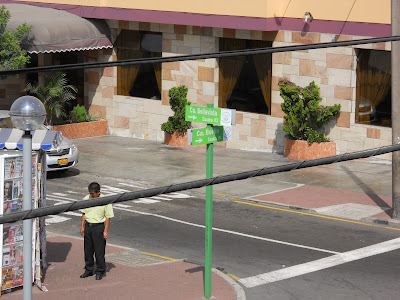
We'd pre-chosen our hostel, on the corner of Berlin & Bellavista,
using the quadruple vector of cheapness, proximity to the bus station at which we'd arrived, its presence in our guidebook and the advertised opportunity to pay with plastic. Aside from those critical features, the Stop and Drop didn't sound like too bad a place. There was, as the ad in our Footprints guide specified, network access, free breakfast, and hot water. We buzzed their door at around 7:30 AM and received a mumble in return as the door opened. The bleary but friendly staff guys, dressed perpetually in pirate, engrish, surfwear, mumbled us through the check-in procedures and we had time to shower before breakfast service began.
After furiously consuming two white rolls, butter, jam and two cups of tea, and making polite conversation with the extremely skinny, middle-aged lady who seemed to be in charge of breakfast every day, sweeping and feeding the roof cat, we left the hostel and, with what must have been by official count our twentieth "second wind" of the bus travel period, went to survey the town, to reschedule our plane tickets, to come up with an alternative to our Nazca outing, to eat food, to check our respective emails and to enjoy life outside a bus.
COMING UP on TrotamundosSA:
1. Video from Lima
2. Our Heroes Match Wits with the Powerful Ladies of LAN
3. God Thwarts More Spectacles
4. Lima is Squeezed for All its Delicious Entertainment Value
5. Miriam and Peter Realize that Since Creating Blog in Cuenca, They Have Neglected to Feed or Clothe it Properly, and Thus They Must Begin to Write In Earnest
6. Indigestion
7. Fuentes Like You Wouldn't Believe!
8. A Blue, Blue Market
When the time finally came to board our bus, the procedure was somewhat different from what had been the norm on our previous rides on the continent. After checking our larger bags we were asked to line up and proceed through a vaguely airport-like security line that involved having our bags and ourselves metal-detected and our identification checked against our tickets. Following this, we got settled on the top floor, and were treated to an airline-style video explication of the safety and convenience features to be found on bus. Most of this, as in the case of airline announcements, was really blase. The exception to this boring list of amenities and rules, was the repeated statement that the toilets onboard were for urine only. URINE ONLY. Just urine! Anyone in need of a more realistic bathroom experience was instructed to knock on the door to the drivers' cabin and request a stop, an action which seemed to me to be a clear violation of the "Don't talk to the driver!" policy which was both announced and also posted in a number of places around the bus.
The bus ride was a funny combination of the intense professionalism and robotic ineffectuality of plane flights everywhere and the down-home, personalized style of service that had come to characterize most of our bus trips up to that point. We played a goofy version of bingo that was, apparent to everyone else in the bus (I couldn't resist calling bingo upon actually getting five in a row), blackout only. We were fed a meal of chicken, yellow rice and a lot of other odd crap that was somewhere roughly on par with airline food. We watched a promotional film that contained a ringing bimbo endorsement of the Nazca area of Peru, and was accompanied by a portion of a catholic sermon taken from 60's era Spanish cinema. After this, we watched an overdubbed version of a moody Jonathan Demme film. Hearing the bellowingly overdubbed Spanish words attempt to carry this film with its subtle themes of familial angst, drug abuse, race relations in the United States and the institution of marriage was fascinatingly confusing, and the only time during the trip that a bus line would elect to pit its passengers against such weighty material :-P.
Outside the bus, was an ongoing parade of landscapes reaching from the arid to the verdant and domiciles made of concrete and rebar, ambiguous in their positions on the continuum of new construction to disrepair.
Before the sun went down, Miriam and I spent a good long time poring over our guides and trying to figure out what to do in Peru in the four or five days that we'd be spending there. Because of the state of the sacred valley, and the apparent lack of things curious, ancient and/or beautiful in the Lima area, we decided on a mosey down toward Nazca in hopes of seeing some lines and perhaps some other coastal archaeological sites as well.
As usual, we arrived very early in the morning, overdressed and partially mummified in cool dry bus air. We had found out from one of our maps that our first task of finding the Grupo Ormeno bus terminal and getting tickets back to Quito ought to be an easy one, due to its location of less than one centimeter away from our present location on the map. We got our bags, adjusted ourselves to the heat and weight, and pushed through a throng of taxi drivers to walk along a major highway. After a couple of circles, we got headed in the right direction and arrived at another bus terminal. We bought the tickets and felt a slight monetary sting, and also much relief. As it turned out, we would still have to change our plane flight from Santiago to Lima to make the schedule fit properly.
Miriam went to the bathroom and I sat in the terminal, feeling as tired and dirty as I had up to that point in the trip. My gaze bounced around the room, out of the windows and into the bustle of the roadways surrounding the terminal, and finally up to the large flat television above the counter. We were watching news and, as I looked, the story took on a more urgent tone, a redder color, and more of the screen. A series of images flashed: small planes, desert shots, ambulances, stretchers and finally petroglyphs. The news from Nazca, our latest destination of choice, was "Plane Crash". Our Peru plans had hit another snag, and we were in need of a fresh Lima alternative.
Miriam returned, and I pointed to the screen and let her watch our plans unravel for herself. We got briefly mad, but we were still just way too filthy to be overly caught up in our misfortune. For now, we needed lodging and hot, running water.
Back outside, on the edge of the great thoroughfare of eighteen or twenty lanes, we started the process of taxi haggling, aided by the price quote we'd received from the woman selling bus tickets. The first driver we asked looked back at us, puzzling over this question himself for a good long time. After a few seconds, he agreed and we tossed our stuff into the back of his taxi station wagon, house-painted yellow with boom box speakers wired up in the back. As we entered the cab, I looked around the vehicle to compare it to those we'd seen before and those we were likely to see in the coming weeks. This was the cab in which it dawned on me that none of the cars we'd ridden in were ever holding even a full half-tank of gas. Also, after we re-entered the cab, our driver asked again what our destination was, and then, seeing that we had a map, asked to borrow our map. This man, with his car full of everyday stuff, was playing cabbie for a day. After watching him drive past our street, in what should have been a well-known tourist district, twice, we finally had him pull over to the corner, and walked the final block.
We'd pre-chosen our hostel, on the corner of Berlin & Bellavista,
 |
| From 2010-02-26 |
using the quadruple vector of cheapness, proximity to the bus station at which we'd arrived, its presence in our guidebook and the advertised opportunity to pay with plastic. Aside from those critical features, the Stop and Drop didn't sound like too bad a place. There was, as the ad in our Footprints guide specified, network access, free breakfast, and hot water. We buzzed their door at around 7:30 AM and received a mumble in return as the door opened. The bleary but friendly staff guys, dressed perpetually in pirate, engrish, surfwear, mumbled us through the check-in procedures and we had time to shower before breakfast service began.
 |
| From 2010-02-26 |
After furiously consuming two white rolls, butter, jam and two cups of tea, and making polite conversation with the extremely skinny, middle-aged lady who seemed to be in charge of breakfast every day, sweeping and feeding the roof cat, we left the hostel and, with what must have been by official count our twentieth "second wind" of the bus travel period, went to survey the town, to reschedule our plane tickets, to come up with an alternative to our Nazca outing, to eat food, to check our respective emails and to enjoy life outside a bus.
COMING UP on TrotamundosSA:
1. Video from Lima
2. Our Heroes Match Wits with the Powerful Ladies of LAN
3. God Thwarts More Spectacles
4. Lima is Squeezed for All its Delicious Entertainment Value
5. Miriam and Peter Realize that Since Creating Blog in Cuenca, They Have Neglected to Feed or Clothe it Properly, and Thus They Must Begin to Write In Earnest
6. Indigestion
7. Fuentes Like You Wouldn't Believe!
8. A Blue, Blue Market
Saturday, March 27, 2010
Food, Food, Food
So, I really like eating. And I spend much of each day dreaming about the food I might presently, or some time in the distant future, be eating. It therefore seems only fair that I attempt to channel some of this enthusiasm into explaining some of the exciting delicious items we get to consume down here.
 which Peter did, and it's in that gigantic glass. Just think about how many strawberries got mushed to make that. Yum. Also we got some standard USA breakfasty items, which is somewhat of a rare thing. Most South Americans eat breakfast of rolls and jam, or sometimes cheese, and instant coffee or tea.

Obviously, out of all the cuisines floating around South America, I am most familiar with Ecuadorian/Northern Andean. So in Quito, I had some very specific cravings that needed to be fulfilled, and some old haunts to visit to do it.
One of my favorite places to eat in the Mariscal is Kallari, especially for breakfast. It's run by a sustainable indigenous cooperative based in the Ecuadorian Amazon. They make delicious delicious dark chocolate, which is awesome 1) because it can be really hard to find decent chocolate around here sometimes, and 2) because although Ecuador is home to some of the best cacao in the world, most large-scale chocolate production isn't controlled by Ecuadorians. The Ecuadorian beans get sent elsewhere to be processed, packaged, etc., and then the chocolate has to be imported back into Ecuador, and they don't really get much out of the profits. Kallari is really exciting because they grow, harvest, produce, and sell their own stuff. And it's really good.
Anyway, their little cafe in Quito has these great breakfast deals, which always create this horrible dilemma: you can get hot chocolate made with their homegrown stuff kind of melted into hot milk, or you can get juice. And you have to pick.
Juice is maybe the very best part of Ecuadorian food. They have about a zillion fruits to choose from, and all the juice is fresh-squeezed, and it's just amazingly good. And you can get juice made out of strawberries,
 which Peter did, and it's in that gigantic glass. Just think about how many strawberries got mushed to make that. Yum. Also we got some standard USA breakfasty items, which is somewhat of a rare thing. Most South Americans eat breakfast of rolls and jam, or sometimes cheese, and instant coffee or tea.
Besides empanadas, which I insisted on eating for pretty much every other meal, what I really couldn't leave Quito without was locro de queso. Soups are another of my favoritist aspects of Ecuadorian cuisine, and locro is my favorite of all the soups. It's kind of a creamy potato soup with chunks of queso fresco (cheese) and potato, and with big ol' slices of avocado on top. I made Peter and Dan go on a locro hunt with me, with excellent results:

Seriously, so good. It's over there on the right. You can also see some empanadas, fried pockets with pretty much whatever you want stuffed inside. The one in front of Dan is an empanada de morocho, which means that the outside is made with morocho, a kind of maize. The red stuff in that little bowl in the center of the table is ají, spicy sauce that's often homemade, and unique to each eatery. Way better than ketchup.
Subscribe to:
Posts (Atom)
